Future of ERPs in the AI Era
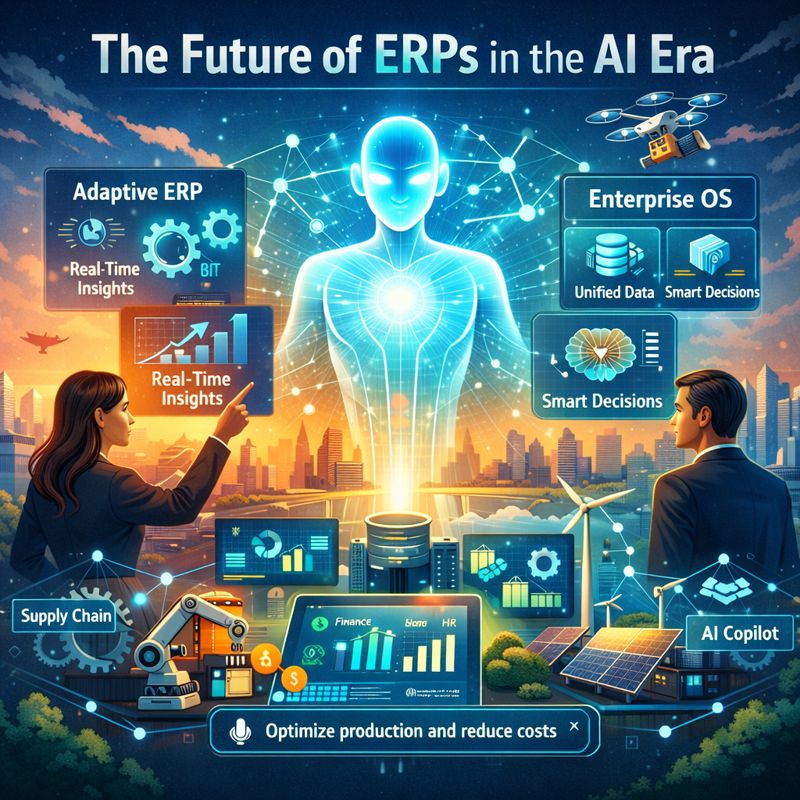
Enterprise software is entering a new era. It used to help us record what already happened. Things like sales, invoices, or payroll. Now it’s starting to understand, think, and even act on its own.
Over the next few years, we’ll see systems that:
- Learn and adapt instead of just record
- Automate work across departments
- Predict problems before they happen
- Connect every part of the business like one living system
This is the beginning of adaptive enterprise software, where apps stop being tools and start becoming intelligent copilots.
Before we go any further, let’s see how we got so far
In the 1990s and 2000s, ERP and CRM systems became the backbone of business. They were strong but rigid. You had to follow their rules.
Then in the 2010s, everything moved to the cloud. Software became easier to access but still followed old workflows. Limited customizations, vendor lock-ins, larger apps and integration footprints started becoming a norm.
Then came 2020 onwards. AI entered the picture. ChatGPT and copilots showed that computers can understand human language. Now this intelligence is coming into enterprise systems, and it’s changing everything. At a more fundamental level.
We’re moving from systems of record to systems of action, and soon to systems that adapt.
My thoughts and predictions on what’s coming in the next 5-10 years.
CoPilots are everywhere
Within a year, every major platform such as SAP, Salesforce, Microsoft, Oracle, Workday will have an AI copilot. And one that actually works.
We’ll no longer dig through menus or search reports. Just simply ask: “Show me pending purchase orders for supplier X” and it will do it for us.
These copilots will handle simple things first: creating orders, checking data, summarizing reports, and generating emails. But as they become smarter, they’ll learn your preferences and company workflows, guidelines and business processes too.
The big question won’t be “Can AI do this?” It will be “Can I trust it to do it right?”. And that question will linger for another year or two until the skeptics are convinced.
Around 3 years we go from copilots to real digital workers
In a few years, AI agents won’t just suggest things. It will start doing them. Thousands of startups are already busy building very specialized AI agents that do just a few very specific things but they get it absolutely on point. Take Eightfold for instance who has agents that do job and profile matching really well, or Tezi who just interviews.
We will start seeing purpose built co pilots that resolve invoice dispute, agents that schedule and conduct interviews after a strong candidate is matched, extract important info from pdfs and docs to update them in the HRIS, suggest margin optimization opportunities, infer and update employee skills, trigger approvals, find master data inconsistencies and fix them, all done automatically.
These “digital workers” or AI agents will take over repetitive work across finance, supply chain, and HR.
AI will become a silent team member that is fast, accurate, works tirelessly and always awake.
5 years down the road? Adaptive ERPs become mainstream
By around 2030, ERPs will evolve from static systems into adaptive systems. Instead of you adapting to the system, the system will adapt to you. Rather than using static systems an adaptive ERP will help accomplish business goals whether or not an app for it exists as it will generate experiences on the flow, give insights and alternatives on highest priority items and automatically execute them for you.
Today you set reorder levels manually. An adaptive ERP will notice supplier delays, forecast shortages, and help auto-adjust reorder levels.
Your finance dashboard will not only show slow receivables. It will recommend actions such as changing credit terms or sending automated reminders.
Your CRM systems will identify risks in quotations, recommend margin optimization opportunities and unify fragmented experiences.
These systems will learn from history, sense real-time signals, and make small continuous adjustments.
They will become more like digital COOs that optimize the business quietly in the background.
Within a decade? The rise of the Enterprise OS
Once every app and agent starts talking to each other, companies will need one brain to connect it all.
That brain will be the Enterprise Operating System, the single layer that coordinates every function.
Think of it like your phone’s operating system. It doesn’t matter which app you open, your phone manages notifications, permissions, and memory.
Now imagine the same for business.
- You’ll just ask: “Why are delivery times increasing this month?”
- The Enterprise OS will check data across ERP, CRM, logistics, HR, and finance, then reply:
- “Shipments are delayed because supplier X is short on materials and overtime approvals are pending in HR.”
- It won’t just report. It will recommend actions. And when you say “Go ahead,” it will trigger those actions — under your company’s policies.
This will mark the true shift from siloed systems to one intelligent operating layer that runs the whole enterprise.
What Enterprises should focus on now
- Get your data house in order – AI only works well when data is clean and connected.
- Build for flexibility – Use APIs and services that make it easy to adopt new AI apps and agents.
- Pick real business use cases – Start small with goals like cutting process time or improving accuracy.
- Make governance non-negotiable – AI must be explainable and traceable, just like finance transactions.
- Prepare your people – New roles will emerge, agent operator, AI officers, agent orchestrator and data steward. And they’ll be key to success.
The big picture
For years, people had to learn how to use enterprise software. In the next decade, software will learn how to work with people.
Workflows will adjust on their own. Insights will appear instantly. Systems will act like teammates that understand your business.
Enterprise software will finally feel fun to work with as they will be flexible, intelligent, and always learning.
Final thought
The future of enterprise software isn’t about adding more AI features. It’s about creating systems that grow smarter every day and evolve with the business. The companies that get this right will move faster, adapt faster, and lead the next era of enterprise innovation.